 Available in US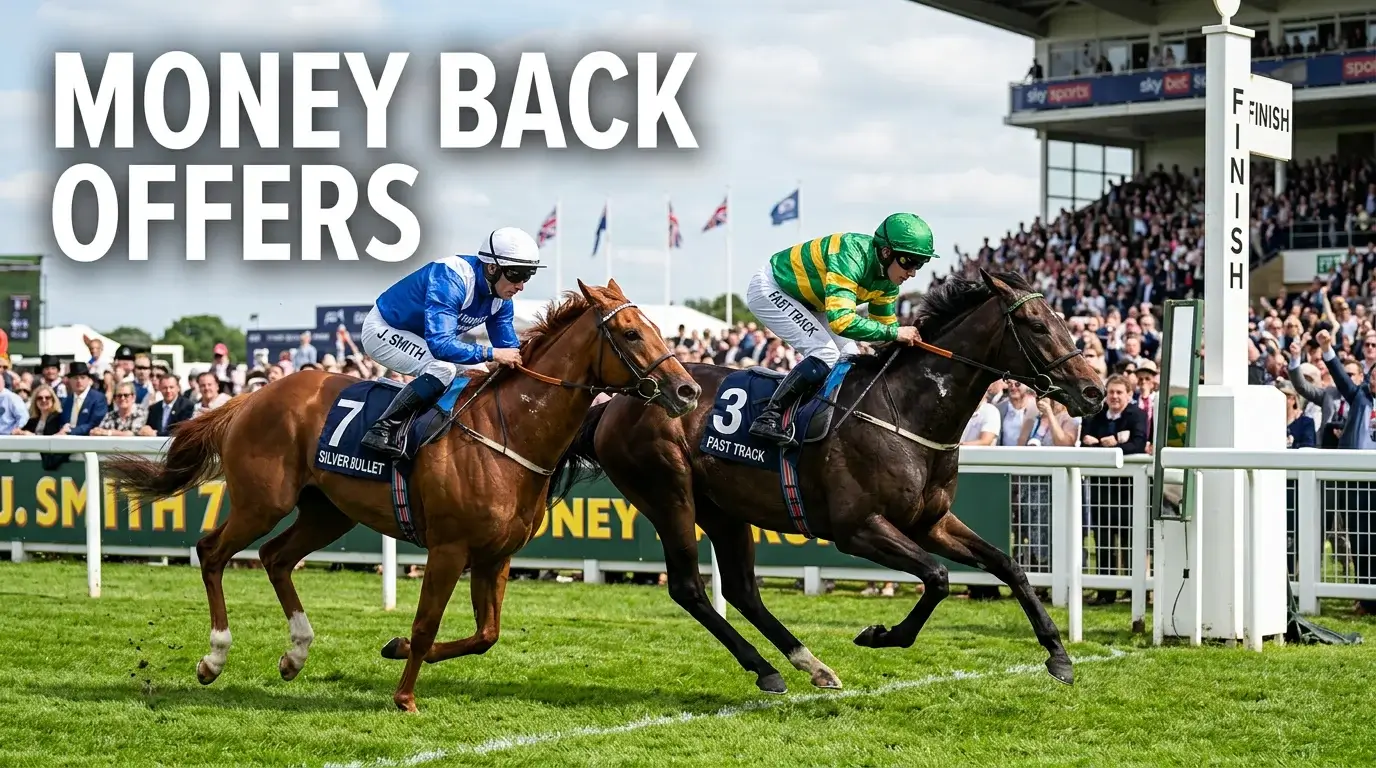
Horse racing money back offers are the promotions that feel most like generosity — your horse finishes second, and the bookmaker refunds your stake. It is the closest thing to a consolation prize in a sport that does not normally hand them out. But understanding the fine print behind money back promises is the difference between a genuinely useful safety net and a marketing slogan dressed up as charity.
The first question to ask is not whether a refund is available, but what form it takes. Cash back into your withdrawable balance is rare and valuable. A free bet returned to your account is far more common — and worth considerably less, typically 70–80% of its face value since you cannot withdraw the stake portion. That distinction alone can halve the real value of what appears to be a generous offer. The second question is what triggers the refund: a second-place finish, a faller, a non-runner, a beaten favourite? Each trigger has different probability and different strategic implications for how you bet.
This guide unpacks every variety of money back promotion you will encounter at UK bookmakers, explains what each is genuinely worth, and identifies the conditions under which they shift the value equation in your favour.
Horse Racing Money Back Offers — More on this topic at horse betting bonus.
Types of Money Back Offers
Money back promotions in horse racing fall into four main categories, each triggered by a different race outcome. They look similar at a glance, but their value profiles are quite different.
Money back if second. The most widely advertised variant. If your horse finishes runner-up, the bookmaker refunds your stake — almost always as a free bet rather than cash. Most operators cap the refund at £10 to £25 and restrict it to selected races: typically the ITV-televised feature race of the day, or a specific meeting during festival periods. The appeal is obvious: second place is the most painful near-miss in horse racing, and removing that sting feels like real protection. The catch is that in a field of 12 runners, the probability of finishing exactly second is roughly 8%, so the offer triggers infrequently. Over fifty bets at £10, you might expect it to fire four or five times, returning £40–£50 in free bets worth perhaps £30–£40 in real terms.
Money back if beaten favourite. This variant refunds your stake if you back the starting price favourite and it loses. It is rarer than the “if second” offer and usually carries a lower cap, but it triggers more often — favourites lose roughly 65–70% of the time in typical UK races. The downside is that the bookmaker controls which races qualify, and they tend to choose fields where the favourite is strong (and therefore less likely to lose). When it does trigger, though, the frequency makes it one of the more consistently valuable money back promotions for punters who routinely back market leaders.
Fallers insurance. This is the money back offer most specific to horse racing, and it carries real weight at particular times of the year. If your horse falls, unseats its jockey, or is brought down during a National Hunt race, the bookmaker refunds your stake. The Grand National is where fallers insurance reaches peak relevance: a field of up to 34 runners tackling 30 fences over four-and-a-quarter miles produces a significantly higher fall rate than any other race on the calendar. In a typical Grand National, anywhere from five to fifteen horses fail to complete the course. The race is expected to generate well over £200 million in bets in 2026, and for many punters, fallers insurance is not a bonus — it is a prerequisite for staking on a race where your selection might not make it past Becher’s Brook.
Non-runner money back. Strictly speaking, most standard bets are voided and stakes returned if a horse is declared a non-runner at the start. But ante-post bets — placed days or weeks before the race — are not. Non-runner money back promotions extend the refund guarantee to ante-post wagers, which is especially valuable in the weeks before major festivals when withdrawal rates are high. A horse that looks a banker for the Champion Hurdle in January might not make the race in March due to injury, and without non-runner money back, your ante-post stake is gone.
The difference between cash and free bet refunds deserves emphasis. A £25 cash refund is £25. A £25 free bet refund is worth roughly £17–£20, because the stake is not returned when you use it. Over a racing season, that 20–30% gap compounds. If you have a choice between two bookmakers offering identical money back promotions but one returns cash and the other returns free bets, the cash version is unambiguously better.
Money Back Offers by Bookmaker
Money back promotions rotate frequently, and the specific offers available on any given Saturday will differ from what was on the table a month earlier. What stays more consistent is each bookmaker’s general approach to refund-style promotions — some lean heavily into money back as a marketing tool, while others prefer extra places or price boosts instead.
The larger operators — bet365, Coral, Ladbrokes, William Hill, Betfair Sportsbook — tend to offer money back promotions on the feature race of the day, particularly on ITV Racing fixtures. The most common format is “money back as a free bet if your horse finishes 2nd to the SP favourite,” capped at £10 or occasionally £25 on bigger race days. During festival weeks, these caps sometimes increase and the number of qualifying races expands from one per day to two or three.
Mid-tier operators frequently use money back promotions more aggressively to differentiate themselves. Where a larger bookmaker might restrict the offer to one race, a smaller competitor may extend it to every race at a particular meeting or offer a wider trigger — money back if your horse finishes 2nd or 3rd, for instance. The trade-off is usually a lower cap (£5–£10 rather than £25) and a free bet refund rather than cash.
Fallers insurance tends to appear only around the Grand National and a handful of other major National Hunt fixtures: the Becher Chase at Aintree in December, the Welsh Grand National at Chepstow, and selected races during the Cheltenham Festival. Outside these windows, fallers insurance is rare. If it matters to you — and for any serious National Hunt bettor, it should — check availability early and register with the operators offering it well before race day.
The broader context matters too. The BHA’s full-year report for 2024 showed that average betting turnover at major festivals dropped by 12.4% compared to the prior year, with Cheltenham alone losing 51,000 in ticket sales relative to 2022. Falling turnover creates pressure on bookmakers to win back recreational punters — and money back offers are one of the most direct tools available. Expect to see more refund promotions in 2026 than in any recent year, particularly around the marquee fixtures where operator competition is fiercest.
Is Money Back Real Value or Marketing?
The honest answer is: it depends on the trigger, the frequency, and the form of refund. Some money back offers carry meaningful expected value; others are more useful to the bookmaker’s marketing department than to your balance.
See also Horse Racing Extra Places.
Consider a “money back if 2nd” offer on a 12-runner handicap, capped at £10. The probability of your selection finishing exactly second is roughly 1 in 12 — about 8.3%. The expected refund per bet is 8.3% × £10 = £0.83 in free bet value, which in cash terms is closer to £0.60. On a £10 stake, that represents a 6% reduction in effective cost. Not nothing, but not transformative either. You would need to place around sixteen qualifying bets before statistically expecting a single refund.
Fallers insurance is a different calculation. In the Grand National, the probability of your horse failing to complete the course has historically been 25–40%, depending on conditions. On a £20 stake with a £20 fallers insurance cap, the expected value of the refund is 30% × £20 = £6 in free bet terms, or roughly £4.50 in real cash value — a 22% reduction in effective cost. That is substantial, and it is why fallers insurance on the Grand National represents some of the best promotional value available in UK horse racing.
Non-runner money back on ante-post bets is harder to quantify because withdrawal rates vary wildly by race and time frame. For a Grand National ante-post bet placed eight weeks out, perhaps 20–30% of entries will not ultimately run. The insurance against that risk has clear value, particularly at longer odds where the ante-post price advantage over the day-of-race price is greatest.
The bottom line: money back offers are worth pursuing when the trigger probability is high (fallers insurance, beaten favourite on competitive races), the refund is cash rather than a free bet, and the cap is large enough to matter relative to your normal stake. “Money back if 2nd” on a single race at a £10 cap is pleasant when it hits, but it should not drive your bookmaker selection or betting strategy. Fallers insurance on the Grand National, on the other hand, is worth registering with a new bookmaker specifically to access.
Disclaimer. Gambling involves risk. Only bet what you can afford to lose. All offers mentioned are subject to change and carry terms and conditions set by individual operators. You must be 18 or over to open a betting account in the United Kingdom. If you feel your gambling is becoming a problem, contact GambleAware or call the National Gambling Helpline on 0808 8020 133.
