
 Available in US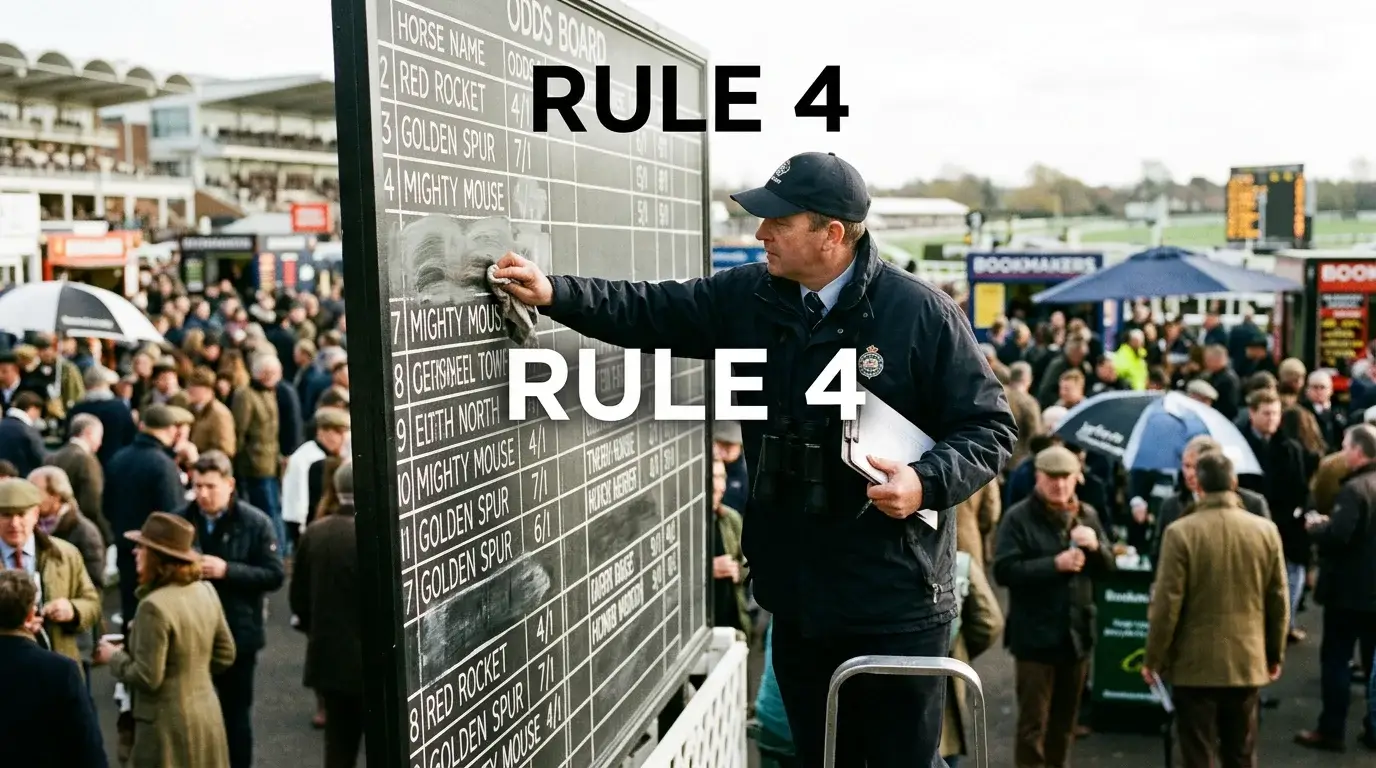
Your horse wins. You check your account expecting a payout of £150, but the settled amount reads £127.50. Nothing went wrong with your selection — it won by three lengths. The issue is a Rule 4 deduction on your free bet, triggered because another horse in the race was withdrawn after the market opened, and the bookmaker adjusted all winning payouts accordingly. Rule 4 — the deduction most punters don’t see coming — is one of the least understood mechanics in horse racing betting, and its impact on free bets can be sharper than on regular cash wagers.
This guide explains what Rule 4 is, how the deduction scale works, why it hits free bets disproportionately hard, and what you can do to reduce the damage.
Rule 4 Deductions Explained — More on this topic at horse betting bonus.
What Is Rule 4 and Why It Exists
Tattersalls Rule 4(c) governs what happens to the odds when a horse is withdrawn from a race after betting has begun. The principle is simple: when a horse is removed from the field, the remaining horses become more likely to win — their probabilities have effectively increased because there is one fewer competitor. If the bookmaker paid out at the original odds without adjustment, they would be overpaying relative to the true probability of each outcome. Rule 4 deductions compensate for this by reducing the payout on winning bets.
The size of the deduction depends on the price of the withdrawn horse at the time of withdrawal. The shorter the odds of the non-runner, the larger the deduction — because a short-priced horse’s removal has a greater impact on the remaining field’s winning chances. The deduction scale works in pence per pound of winnings, and the full range runs from 5p in the pound (for withdrawals at 14/1 or longer) up to 90p in the pound (for withdrawals at odds of 1/7 or shorter).
The standard tiers work roughly as follows. If the withdrawn horse was priced at evens to 6/5, the deduction is 45p in the pound. If it was 5/4 to 6/4, the deduction is 35p. At 13/8 to 7/4, it is 30p. At 15/8 to 9/4, 25p. At 5/2 to 3/1, 20p. At 7/2 to 4/1, 15p. At 9/2 to 9/1, 10p. And at 10/1 to 14/1, 5p. Horses withdrawn at longer than 14/1 do not trigger a deduction.
In practical terms: if you backed the winner at 4/1 with a £10 stake, and the Rule 4 deduction is 25p in the pound, your winnings of £40 are reduced by 25% — a deduction of £10 — leaving you with £30 in winnings plus your £10 stake, totalling £40 instead of £50. That is a noticeable cut.
Rule 4 is most likely to apply at major festivals where large fields and high-profile withdrawals are common. William Hill projects roughly £450 million in bets across the Cheltenham Festival 2026 alone. In an event of that scale, with 28 races over four days and hundreds of declared runners, at least a handful of post-declaration withdrawals are virtually guaranteed — each one triggering Rule 4 deductions that affect every winning bet in the affected race.
Rule 4 and Free Bets: The Hidden Impact
Rule 4 deductions affect free bets more harshly than cash bets, because a free bet is already operating at a structural disadvantage: the stake is not returned. When a Rule 4 deduction reduces the winnings on a free bet, it eats into the only part of the payout you actually receive.
Consider a worked example. You use a £30 free bet (stake not returned) on a horse at 4/1. Without Rule 4, your payout is the profit only: £30 × 4 = £120. Now suppose a horse in the race is withdrawn at a price that triggers a Rule 4 deduction of 25p in the pound. The deduction is applied to the winnings: 25% of £120 = £30. Your payout drops to £90. That £30 Rule 4 deduction represents a 25% reduction in your total return, and because the £30 stake was never part of your payout anyway, the deduction hits proportionally harder than it would on a cash bet — where you would still receive your original £30 stake back regardless of the deduction.
On a cash bet at 4/1 with a £30 stake, the same 25p Rule 4 deduction reduces winnings from £120 to £90, but you still receive your £30 stake back, giving a total return of £120 instead of £150. The loss is £30 on £150, or 20%. On the free bet, the loss is £30 on £120 (since you never had the stake return), or 25%. The free bet suffers a steeper percentage hit.
The Grand National is the race where Rule 4 and free bets collide most frequently. With a maximum field of 40 runners, late withdrawals are routine — sometimes three or four horses are taken out on the morning of the race, and if one of them was a prominent contender at single-figure odds, the cumulative Rule 4 deduction can reach 15–20p in the pound. Across the expected £200 million-plus in bets on the National, Rule 4 deductions redistribute a significant sum from punters back to the bookmaker.
For each-way free bets, Rule 4 applies to both the win and place parts. If you used a £20 each-way free bet (£10 win, £10 place) and a Rule 4 deduction of 15p applies, both the win winnings and the place winnings are reduced by 15%. On a horse that places at 1/4 odds on a 10/1 shot, the place winnings drop from £25 to £21.25 — and remember, you are not getting the £10 place stake back either. Every layer of the free bet’s value gets compressed.
See also Horse Racing Loyalty Rewards.
How to Minimise Rule 4 Impact
You cannot eliminate Rule 4 risk entirely, but you can reduce your exposure with a few practical steps.
Bet late. The closer to the start of the race you place your bet, the lower the chance that a subsequent withdrawal will trigger a Rule 4 deduction. If you take a price at 10:00 am and a horse is withdrawn at 1:00 pm, your bet is subject to the deduction. If you wait until 2:55 pm (five minutes before the off), the window for withdrawals is almost closed. The trade-off is that you may not get the best early price — but for a free bet, where you are not risking your own money, the priority should be protecting the payout rather than chasing an extra half-point on the odds.
Check best odds guaranteed coverage. BOG protects you if the starting price is higher than the price you took, effectively giving you the best of both worlds. But BOG does not override Rule 4 — the deduction is still applied to your winning price (whether that is the price you took or the SP, whichever is better). What BOG does protect against is a separate scenario: taking an early price that subsequently drifts, regardless of any withdrawals. If a bookmaker applies BOG after Rule 4 adjustments, you receive the higher price minus the deduction. If they do not, the Rule 4 deduction is applied to the original price you took. Confirm the sequence with your bookmaker if the terms are unclear.
Avoid races with fragile market leaders. A race where the favourite is in doubt — perhaps due to the going, a fitness concern, or a trainer’s ambiguous comments — carries higher Rule 4 risk than a race with a well-established, committed favourite. If the market leader is withdrawn at odds of 6/4, the deduction could be 35p or more in the pound. That risk is avoidable by choosing races where the field is relatively stable.
Use free bets on races with large fields at longer odds. In a 20-runner handicap, the withdrawal of a 20/1 shot triggers no deduction at all (prices beyond 14/1 are deduction-free). The withdrawal of a 10/1 shot triggers only 5p in the pound. Large-field handicaps are where the impact of any single withdrawal is smallest, making them the safest environment for deploying a free bet if you want to minimise Rule 4 exposure.
Disclaimer. Gambling involves risk. Only bet what you can afford to lose. All offers mentioned are subject to change and carry terms and conditions set by individual operators. You must be 18 or over to open a betting account in the United Kingdom. If you feel your gambling is becoming a problem, contact GambleAware or call the National Gambling Helpline on 0808 8020 133.
