
 Available in US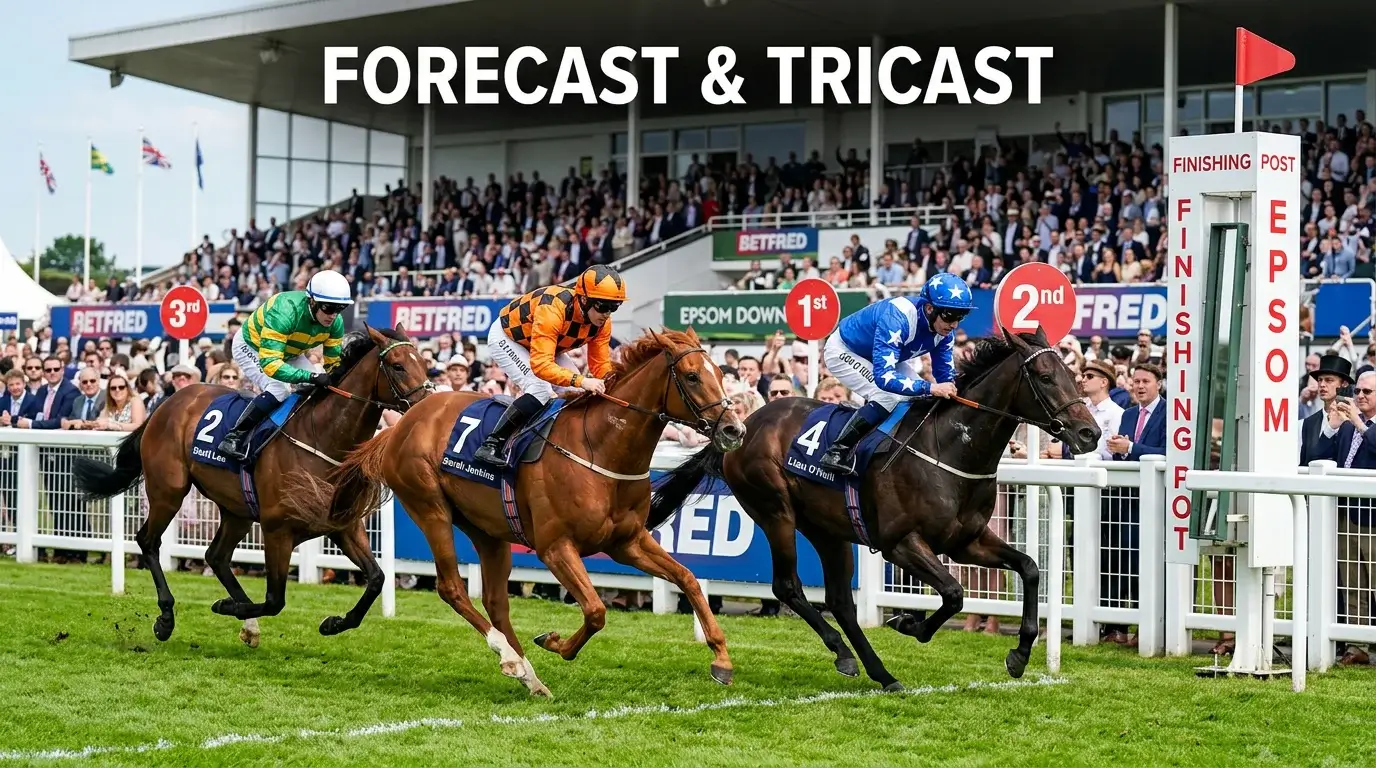
A horse racing forecast tricast bet asks you to do something that sounds straightforward but is fiendishly difficult in practice: predict not just the winner of a race, but the exact finishing order of the top two or top three horses. A forecast covers first and second; a tricast covers first, second, and third. Predicting the exact finish — forecast and tricast bets explained — reveals a bet type capable of delivering enormous payouts from tiny stakes, but one that most punters understand only partially.
The mechanics involve variations — straight, reverse, combination — that change both the cost and the probability of winning. The payout calculation uses either a computer-generated formula or a declared dividend, depending on how the bet was placed. And the question of whether free bets can be used on forecasts and tricasts is not as simple as you might hope. This guide covers all of it.
Horse Racing Forecast & Tricast Betting — More on this topic at horse betting bonus.
Types of Forecast and Tricast Bets
Straight forecast. The simplest version: you name the horse that will finish first and the horse that will finish second, in the correct order. If you select Horse A to win and Horse B to finish second, your bet only pays out if A beats B and B finishes runner-up. If B wins and A is second, you lose. A £1 straight forecast is a £1 total stake.
Reverse forecast. You select two horses and your bet covers both possible finishing orders: A first and B second, or B first and A second. This doubles the cost — a £1 reverse forecast is two £1 bets, costing £2 — but doubles the chance of winning. In races where two horses are clearly the strongest in the field but you are unsure which will come out on top, a reverse forecast is the natural choice.
Combination forecast. You select three or more horses, and the bet covers every possible first-and-second combination among them. With three horses (A, B, C), there are six possible combinations: A-B, A-C, B-A, B-C, C-A, C-B. A £1 combination forecast across three horses costs £6. With four horses, the permutations rise to twelve, costing £12. The cost escalates quickly, but in a competitive race where several horses have a realistic chance of finishing in the top two, a combination forecast is the most flexible way to cover the field.
Straight tricast. You name the first three finishers in exact order. The difficulty is substantially higher than a forecast — you are adding a third variable to an already challenging prediction. But the payouts reflect this. In large-field handicaps, tricast dividends routinely reach three or four figures from a £1 stake. The horse racing market in Britain generates £766.7 million in online gross gaming yield annually, according to Gambling Commission data, and a meaningful slice of that market involves forecast and tricast betting — particularly during the big Saturday handicaps where competitive fields create the conditions for outsized dividends.
Combination tricast. You select three or more horses and cover all possible first-second-third permutations. Three horses produce six permutations; four horses produce twenty-four. The cost of a £1 combination tricast on four selections is £24, which makes it expensive — but in return, any finishing order among your selected horses wins. This is the high-risk, high-reward play for big handicaps where you have a shortlist of four or five contenders and want to cover every scenario.
How Payouts Are Calculated
Forecast and tricast payouts work differently from standard win or each-way bets. Instead of a fixed odds price offered by the bookmaker, the return is determined by one of two methods: the Computer Straight Forecast (CSF) or Tricast dividend, or a declared price offered by the bookmaker at the time of bet placement.
Computer Straight Forecast (CSF). This is a formula-based payout calculated after the race based on the starting prices of all runners. The CSF takes into account the prices of the first and second-placed horses and the size of the field to generate a fair dividend. It is the default settlement method for forecasts placed with bookmakers when no fixed-odds forecast price was offered. The CSF typically produces generous returns when both finishers are at longer odds, and more modest returns when a short-priced favourite fills one of the positions. A CSF of £30 means a £1 straight forecast returns £30.
Tricast dividend. For tricasts, the payout is calculated by the Tote (or a computer model replicating Tote dividends) based on the pool of money wagered on the race. Tricast dividends in large-field handicaps can be spectacular. In a 20-runner handicap where three outsiders fill the first three places, tricast dividends of £500 to £5,000 from a £1 stake are not uncommon. The Grand National, with its 40-runner field and inherent unpredictability, regularly produces some of the largest tricast dividends of the year. Over £200 million in bets are expected on the 2026 National, and the tricast pool on that race alone can run into the millions — generating dividends that occasionally reach five figures.
Declared forecast odds. Some bookmakers offer fixed-odds forecast prices on selected races, typically the feature race of the day. These are advertised as “forecast odds” and allow you to see the exact payout before placing the bet, unlike the CSF which is only calculated post-race. Declared prices are sometimes more generous than the CSF (when the bookmaker is competing for forecast volume) and sometimes less generous (when the market is thin). Where available, compare the declared price against the likely CSF range before deciding which method to use.
One critical point: forecast and tricast bets are void if there are fewer runners than the number of positions required. A race needs at least three runners for a forecast and at least three finishers for a tricast. If the field reduces below these thresholds due to non-runners, all forecast and tricast bets are void and stakes returned.
Using Free Bets on Forecasts and Tricasts
Not all bookmakers allow free bets to be used on forecast or tricast markets. This is one of those restrictions that catches punters by surprise — you receive a £30 free bet, attempt to place a combination tricast, and the bet slip rejects it.
See also Live Horse Racing Streaming.
The major operators are split on this point. Some — including bet365 and a few mid-tier bookmakers — permit free bets on all bet types including forecasts and tricasts. Others restrict free bets to win and each-way markets only, explicitly excluding forecast, tricast, and combination bets. A handful allow forecasts but not tricasts, or vice versa. Check the free bet terms before planning your usage.
If your bookmaker does allow free bets on forecasts and tricasts, the SNR mechanic still applies: you only collect the profit, not the stake. On a £10 free bet placed as a straight forecast that pays a CSF of £45, your return is £45 minus the £10 stake = £35. The expected value calculation is more complex than for a standard win bet, because forecast and tricast probabilities are harder to estimate — but the potential upside is correspondingly higher.
A practical strategy: if you have multiple small free bet tokens (e.g., 4 × £5), consider using one or two on straight forecasts in big-field handicaps where the CSF is likely to be large. The expected value per bet is low (forecasts are hard to land), but the maximum payout from a £5 free bet on a forecast can easily exceed £100 — a return you would struggle to achieve with a standard win bet at sensible odds. Think of it as a lottery ticket that costs you nothing, deployed alongside your more calculated each-way free bets.
Disclaimer. Gambling involves risk. Only bet what you can afford to lose. All offers mentioned are subject to change and carry terms and conditions set by individual operators. You must be 18 or over to open a betting account in the United Kingdom. If you feel your gambling is becoming a problem, contact GambleAware or call the National Gambling Helpline on 0808 8020 133.
