
 Available in US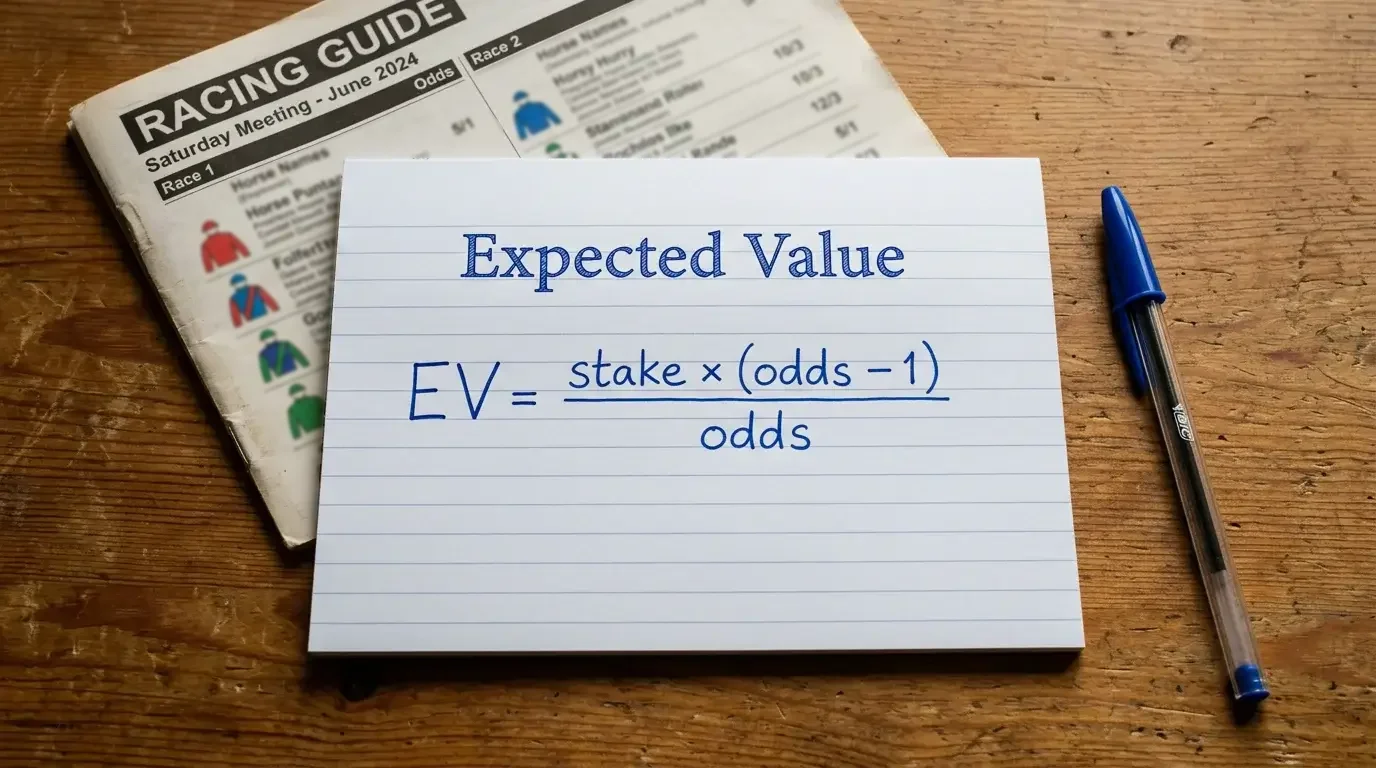
The expected value of free bets is the number that the entire UK betting bonus industry would prefer you not to calculate. A £30 free bet is not worth £30. If it is stake-not-returned (SNR) — which is the overwhelming majority — its real cash equivalent sits between £21 and £24, depending on the odds you use it at. If it is stake-returned (SR), it is worth closer to £28–£29. The maths behind your bonus — what a free bet is actually worth — is not difficult, but none of the top ten competitor sites in this niche bother to show it. This article does.
Expected value (EV) is the average amount you would receive if you used the same free bet an infinite number of times. It strips out luck and reveals the underlying mathematical worth. Once you understand EV, you will never look at a “bet £10 get £30” offer the same way again — not because it is bad value (it usually is good value), but because you will know exactly how good.
Expected Value of Free Bets — More on this topic at horse betting bonus.
EV Formula for SNR Free Bets
A stake-not-returned free bet pays out only the profit if it wins. The stake itself is not included in the payout. The EV formula for an SNR free bet, assuming you are betting at fair odds (no bookmaker margin), is:
EV = stake × (odds − 1) / odds
In decimal odds, this simplifies to: EV = stake × (1 − 1/odds). The retention rate — the percentage of the free bet’s face value you expect to extract — is (odds − 1) / odds.
Here is how that works across a range of odds for a £30 SNR free bet. At fractional odds of 2/1 (decimal 3.0), the retention rate is (3 − 1) / 3 = 66.7%, giving an EV of £20.00. At 3/1 (4.0), it rises to 75.0% — EV of £22.50. At 4/1 (5.0), 80.0% — £24.00. At 5/1 (6.0), 83.3% — £25.00. At 6/1 (7.0), 85.7% — £25.71. At 8/1 (9.0), 88.9% — £26.67. And at 10/1 (11.0), 90.9% — £27.27.
The pattern is clear: retention rate increases with odds, but the marginal gain flattens. The jump from 2/1 to 4/1 adds 13.3 percentage points of retention. The jump from 4/1 to 8/1 adds only 8.9 points. The jump from 8/1 to 10/1 adds just 2 points. This diminishing return is why most analysts recommend using SNR free bets at odds between 4/1 and 7/1 — high enough for a good retention rate, but not so high that the probability of the bet winning (and thus the probability of actually receiving the payout) becomes too low.
There is an important caveat: the formula above assumes fair odds — that is, the odds accurately reflect the true probability of the outcome. In reality, bookmaker odds include a margin (overround) of 3–15% depending on the market. This means the true retention rate is slightly lower than the formula suggests. At 5/1 with a 5% overround, the effective EV is closer to £23.75 than £25.00. For practical purposes, this margin is small enough that the formula provides a reliable guide.
The regulatory context makes EV calculations more relevant than ever. The Gambling Commission’s 10x wagering cap, introduced in January 2026, has simplified the bonus landscape. With clearer terms and lower wagering requirements, calculating the true value of a promotion has become more straightforward — and more rewarding, because the gap between advertised value and real value has narrowed.
EV Formula for SR Free Bets
A stake-returned (SR) free bet pays out both the profit and the stake if it wins. This makes it worth more than an SNR free bet at any given odds. The EV formula for an SR free bet is simply:
EV = stake × (1 − 1/odds) + stake × (1/odds) × 0 = stake × (odds − 1) / odds + stake / odds = stake
Wait — that suggests an SR free bet is always worth its full face value. And in theory, at fair odds, it is. A £30 SR free bet has an EV of £30, because whether the bet wins or loses, the expected return equals the stake. When the bet wins (probability 1/odds), you receive the stake plus profit. When it loses (probability (odds-1)/odds), you receive nothing — but the expected values sum to £30.
In practice, SR free bets are worth slightly less than face value because of the bookmaker’s margin. At 5/1 with a 5% overround, the EV drops to approximately £28.50 rather than £30. The reduction is modest but real.
SR free bets are rare in UK horse racing promotions. The vast majority of welcome offers and ongoing promotions issue SNR tokens. When an SR free bet does appear — typically as a refund for a non-runner or as part of a specific festival promotion — it carries measurably higher value than its SNR equivalent and should be prioritised accordingly.
The distinction matters more as bonus values face downward pressure. The Office for Budget Responsibility projects that gambling duty reforms will raise up to £1.16 billion by 2030/31, with operators expected to pass roughly 90% of the cost to consumers. As headline free bet values shrink in response, extracting maximum EV from each token becomes increasingly important. A bettor who consistently uses SNR free bets at 2/1 (66.7% retention) instead of 5/1 (83.3% retention) leaves approximately 17% of the available value on the table — a gap worth £5 per £30 free bet, or over £50 across a year of regular bonus claiming.
Practical EV Calculations for Common Offers
See also Horse Racing Betting Strategy.
Bet £10 Get £30 in SNR free bets. Your qualifying bet costs approximately £0.50–£2.00 in expected loss (depending on the minimum odds and the market you use). The £30 in free bets, used at average odds of 5/1, has an EV of £25.00. Subtract the qualifying cost, and the net EV of the entire offer is approximately £23–£24.50. That is the real value of “bet £10 get £30” — solid, but not £30.
Deposit match £20 at 10x wagering. You receive £20 in bonus funds and must wager £200 in total to clear them. Each qualifying bet carries an expected loss of roughly 3–5% (the bookmaker’s margin), totalling £6–£10 in cumulative wagering costs over £200. Net EV: £10–£14. Lower than the free bet equivalent, but more predictable in outcome.
Bet £10 Get £40 in SNR free bets (festival offer). Same mechanics, larger headline number. Qualifying loss: £0.50–£2.00. Free bet EV at 5/1: £33.33. Net EV: approximately £31–£33. The additional £10 in free bets (compared to a standard “get £30” offer) adds roughly £8 in real value. Timing your registration to coincide with a festival when operators inflate their offers delivers a measurable premium.
A note from an industry critic adds useful perspective. The advocacy site Casinomeister has observed that the 10x wagering cap “sounds great on paper” but in practice, some operators exclude popular markets or apply contribution weightings that reduce the effective clearance rate. For horse racing bettors, this concern is less acute — racing markets typically qualify at 100% contribution — but it is worth verifying for any deposit match offer.
The ultimate takeaway is mathematical: every bonus has a calculable value, and that value is always less than the headline number but usually positive. A bettor who claims four welcome offers across different bookmakers, each with an expected net value of £23, generates £92 in real profit from approximately £40 in qualifying bets. That is a return on investment of over 200%, achieved without any opinion on horses and without any gambling risk beyond the small qualifying losses. EV calculation is not an academic exercise — it is the foundation of profitable bonus use.
Disclaimer. Gambling involves risk. Only bet what you can afford to lose. All offers mentioned are subject to change and carry terms and conditions set by individual operators. You must be 18 or over to open a betting account in the United Kingdom. If you feel your gambling is becoming a problem, contact GambleAware or call the National Gambling Helpline on 0808 8020 133.
