
 Available in US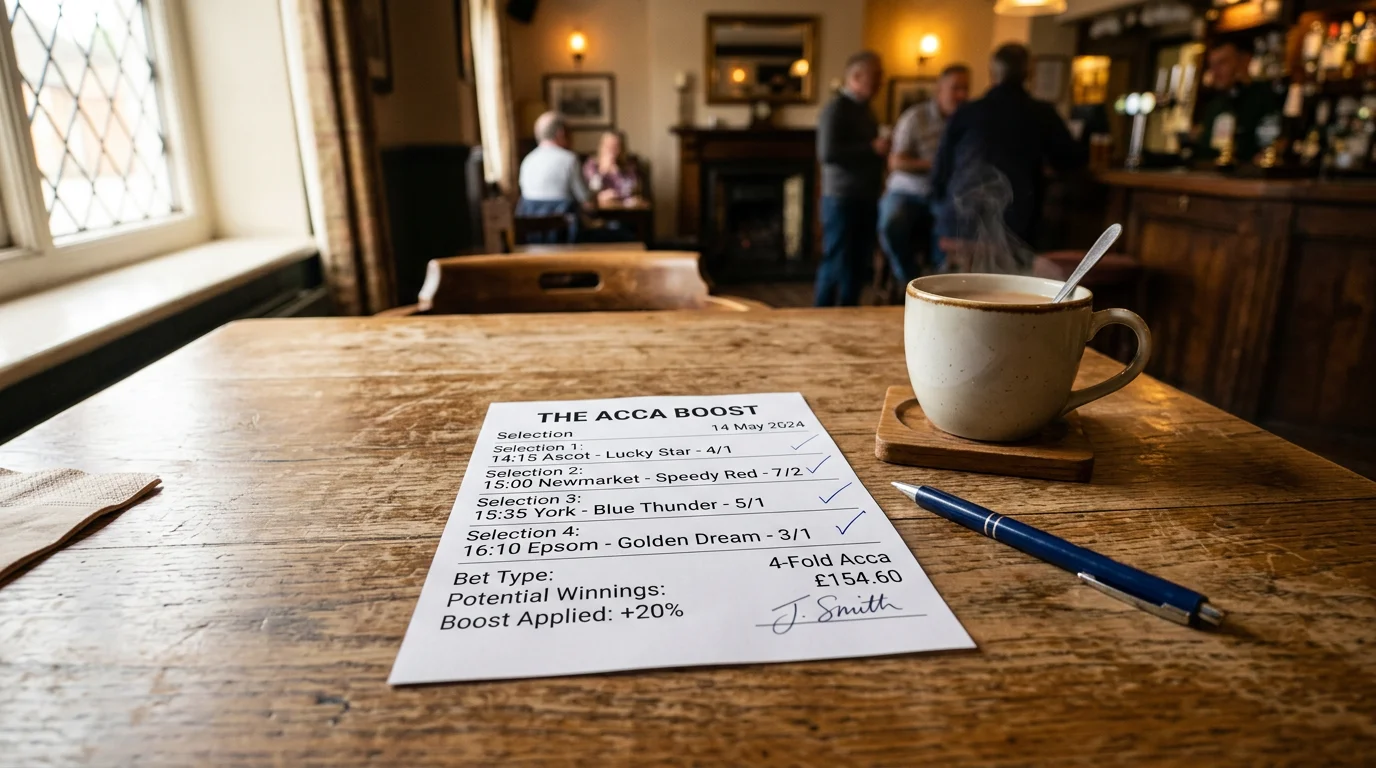
A horse racing acca boost turns a good Saturday into a great one. Picture this: you string together four winners from the afternoon card, your accumulator lands at combined odds of 25/1, and then your bookmaker adds 10% — or 20%, or 50% — on top of your net winnings. That bonus is not theoretical. It is cash or near-cash, paid into your account within minutes of the last leg settling.
Accumulators are the most volatile bet type in horse racing. Most lose. The ones that win, though, can deliver returns that no single or each-way bet comes close to matching, and acca boosts exist to amplify that upside. Bookmakers offer them because they know the vast majority of accas fail — the bonus costs them very little in aggregate while generating enormous engagement. For the punter, stacking the odds in your favour with acca boosts means understanding exactly how the bonus is calculated, which conditions apply, and when acca insurance might serve you better than a straight boost.
Horse Racing Acca Boost — More on this topic at horse betting bonus.
How Acca Boosts Work
The mechanics of an acca boost are straightforward, but the details vary enough between bookmakers that it pays to read the terms before placing your bet.
The basic principle: when all legs of your accumulator win, the bookmaker adds a percentage bonus to your net profit (winnings minus your stake). The bonus percentage typically scales with the number of legs. A four-fold might earn a 5–10% boost; a five-fold, 10–20%; a six-fold or higher, 20–50% or more. Some operators cap the bonus at a fixed amount — £100 or £250 is common — while others impose no cap but set tighter conditions on qualifying.
Here is a worked example. You place a £10 four-fold accumulator on Saturday’s racing. Your selections all win, and the combined odds are 20/1. Without a boost, your return is £210 (£200 profit + £10 stake). With a 10% acca boost, the bookmaker adds 10% of your £200 profit — that’s £20 — bringing your total return to £230. Simple arithmetic, but an extra £20 for doing nothing beyond ticking the acca boost opt-in box is not to be dismissed.
The scaling structure matters. At five legs with a 20% boost on the same £10 stake and combined odds of 40/1, your profit is £400 and the boost adds £80. At six legs with a 30% boost and odds of 80/1, the boost adds £240 to an £800 profit. The exponential nature of accumulator odds means the absolute value of the boost grows rapidly with each additional leg — which is precisely why bookmakers are comfortable offering it. The probability of landing a six-fold in horse racing is low enough that the bonus rarely pays out.
Conditions to watch. Most acca boost offers require minimum odds per leg — typically 1/5 (1.20 decimal) or higher, sometimes 1/2 (1.50) or evens. This prevents you from padding the accumulator with near-certainties to farm the boost. Some operators also require all selections to be from different races or different meetings, ruling out the strategy of picking three short-priced favourites from the same card. A few restrict the offer to pre-match prices only, excluding in-play bets — less relevant for horse racing, where in-play betting is minimal, but worth noting.
The Gambling Commission’s 10x wagering cap, introduced in January 2026, applies to bonus funds and deposit matches rather than acca boosts paid as cash. However, if a bookmaker pays the acca boost as a free bet or bonus credit rather than cash, the 10x limit governs how many times you must wager that bonus before withdrawing it. Always check whether the boost is paid as withdrawable cash or as a free bet with conditions attached.
Acca Boost vs Acca Insurance
These two promotions are often mentioned in the same breath, but they do fundamentally different things. An acca boost rewards success: if all your legs win, you get a bonus. Acca insurance cushions failure: if one leg lets you down, you get your stake back.
The appeal of acca insurance is emotional as much as mathematical. Anyone who has watched three horses win only for the fourth to stumble at the second-last fence knows the feeling. Insurance removes that specific sting by refunding your original stake — usually as a free bet, occasionally as cash — when exactly one selection loses. If two or more legs fail, the insurance does not apply.
From a value perspective, acca insurance is more likely to trigger than an acca boost. The probability of landing three out of four legs but missing one is substantially higher than the probability of landing all four. This means acca insurance pays out more frequently but delivers less when it does — you recover your stake rather than amplifying your profit. An acca boost, by contrast, pays out rarely but adds meaningfully to an already large win.
When should you prefer one over the other? If you are building an accumulator from selections you genuinely believe will win, an acca boost adds more expected value over time — you are betting on outcomes you expect, and the boost magnifies the reward. If your accumulator includes one or two speculative selections at longer odds and you want protection against the weakest leg failing, acca insurance makes more sense.
There is also a structural question about horse racing specifically. Unlike football, where accas might include odds-on favourites across multiple leagues, horse racing accumulators tend to involve higher-variance selections. A four-fold on Saturday’s feature races might combine odds of 3/1, 5/2, 7/2, and 4/1 — none of which are close to certainties. In this context, the probability of landing all four is low (roughly 2–3% at those prices), and the probability of missing exactly one is around 10–15%. This makes acca insurance disproportionately more likely to pay out relative to an acca boost.
The BHA reported that overall betting turnover on British horse racing fell 6.8% year-on-year in 2024, with a sharper decline among higher-stakes bettors affected by affordability checks. That downward pressure has intensified competition for recreational punters, and accumulators — with their high engagement and natural social-media appeal — have become a key battleground. Expect both acca boosts and acca insurance offers to become more generous through 2026 as operators fight for market share in a shrinking turnover environment.
Best Acca Boost Offers by Bookmaker
Acca boost and acca insurance offers shift regularly, so any snapshot is just that — a snapshot. What matters is understanding the structure each operator uses, so you can evaluate new offers as they appear throughout 2026.
See also Matched Betting Horse Racing.
The major UK bookmakers typically fall into one of three categories. The first group offers a percentage boost that scales with the number of legs: 5% for doubles, rising through 10%, 15%, 20%, and up to 50% or more for larger multiples. Minimum odds per leg usually sit at 1/5 or 1/4, and the maximum bonus payout is capped — often at £100 for standard accounts. This is the most common structure and the easiest to calculate value from.
The second group focuses on acca insurance rather than boosts, refunding your stake as a free bet if one leg fails. These offers typically require four or more legs, minimum odds per leg of 1/2 or higher, and a maximum stake of £20–£50. The refund is almost always a single free bet with a 3–7 day expiry, so it needs to be used promptly. For horse racing, where the variance on a four-fold is inherently high, this structure appeals to punters who build accumulators frequently and want a cushion against regular near-misses.
The third, smaller group combines both: a boost when all legs win and insurance when one fails. These dual-offer structures are the most attractive on paper, but they tend to come with tighter restrictions — higher minimum odds per leg (often evens or above), caps on the number of racing markets allowed, or limits on the total stake. Read the conditions carefully; a dual offer with stringent requirements can deliver less real value than a straightforward single boost with relaxed terms.
A few practical considerations when choosing. First, confirm that horse racing markets are eligible. Some operators restrict their acca promotions to football or “selected sports,” with horse racing excluded. Second, check whether each-way accumulators qualify — most do not. Acca boosts are almost universally limited to win multiples. Third, look at the cap: a 50% boost with a £50 cap delivers less than a 20% boost with a £500 cap once your accumulators start returning serious profits.
Finally, consider frequency. Some operators run their acca boost as a permanent feature; others activate it only on weekends or during specific festivals. A permanent acca boost that you can rely on every Saturday afternoon — even at a lower percentage — often represents better long-term value than a flashy one-off promotion that disappears after Cheltenham.
Disclaimer. Gambling involves risk. Only bet what you can afford to lose. All offers mentioned are subject to change and carry terms and conditions set by individual operators. You must be 18 or over to open a betting account in the United Kingdom. If you feel your gambling is becoming a problem, contact GambleAware or call the National Gambling Helpline on 0808 8020 133.
