
 Available in US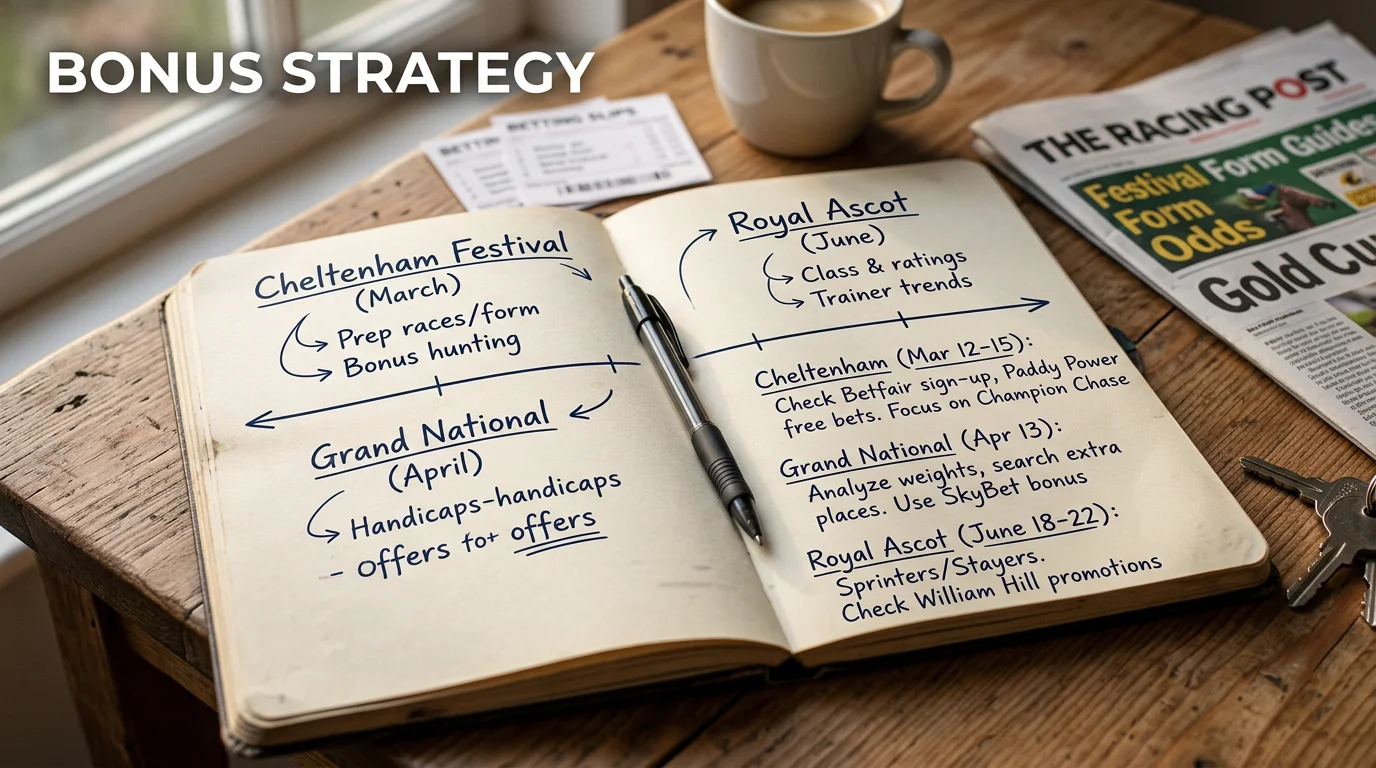
A horse racing betting strategy built around bonuses is not a gamble — it is a system. Most punters treat bonuses as a pleasant extra: claim the welcome offer, use the free bets on whatever race catches the eye, and move on. That approach leaves value on the table. Turning bonuses into a systematic betting edge requires treating each offer as a mathematical input — with a calculable expected value, an optimal deployment window, and a place within a broader portfolio of bookmaker accounts and promotional cycles.
This is not about predicting winners. It is about structuring your activity so that the bonuses and promotions available from UKGC-licensed bookmakers deliver a measurable, repeatable return — regardless of whether your selections win or lose on any given Saturday.
Horse Racing Betting Strategy — More on this topic at horse betting bonus.
Bankroll Management with Bonuses
The first principle of bonus-driven strategy is separation: your bonus-related activity should be tracked independently from your recreational betting. This does not mean opening separate bank accounts — it means maintaining a mental (or, better, a spreadsheet-based) distinction between money staked as part of a bonus strategy and money staked because you fancy a horse.
Your bonus bankroll is the pot of money you use for qualifying bets, deposit matches, and the associated hedging activity. It needs to be large enough to absorb the qualifying losses that unlock free bets. A typical qualifying bet on a “bet £10 get £30” offer generates a loss of £0.50 to £2.00. Across four bookmakers, that is £2 to £8 in qualifying costs to unlock £120 in free bets worth roughly £84–£96 in real value. The return on capital is excellent, but you need to have the qualifying funds available and be prepared to see a temporary dip before the free bets are credited and converted.
A sensible starting bankroll for bonus activity is £50–£100. This covers qualifying bets at four to six bookmakers, provides a buffer for variance in qualifying bet outcomes, and leaves room for any deposit match wagering that requires multiple bets to clear. As your bonus bankroll grows from converted free bets, you can reinvest part of the profits into qualifying for additional offers — a compounding cycle that accelerates with each new bookmaker account.
Staking discipline matters here as much as in traditional betting. The temptation when using a £30 free bet is to throw it at a 20/1 long shot for the thrill. The disciplined approach is to use it at 4/1 to 7/1, where the retention rate is highest and the probability of collecting is reasonable. Over dozens of free bets, the difference between disciplined deployment and impulsive use adds up to hundreds of pounds in expected value.
The broader market context reinforces the importance of strategic thinking. The BHA reported that overall betting turnover on British racing fell 6.8% year-on-year in 2024. In a contracting market, bookmakers compete harder for remaining customers — which means promotional budgets remain elevated even as the total pie shrinks. For the strategic bettor, a declining market is paradoxically a good market: more offers chasing fewer bettors.
Diversifying Across Bookmakers
Holding accounts at a single bookmaker is the most common strategic error among UK racing bettors. It restricts you to one set of odds, one set of promotions, and one welcome bonus. The alternative — maintaining active accounts at four to six operators — multiplies your access to value at every level.
The welcome bonus alone justifies multi-account registration. Four “bet £10 get £30” offers generate roughly £84–£96 in real value from a combined qualifying investment of £40. But the ongoing benefits are equally significant. Different bookmakers offer different daily promotions: Bookmaker A might have extra places on the 2:30 at Newbury while Bookmaker B has a price boost on the same race. By holding accounts with both, you can choose the better deal for each individual bet. Over a season, this optionality compounds into a significant edge — not from picking more winners, but from consistently betting at better prices and accessing better promotions.
The portfolio approach also protects against gubbing. If one bookmaker restricts your account (which happens when operators detect patterns consistent with bonus-focused activity), you still have access to promotions at three or four other operators. Concentrating all activity with a single bookmaker creates a single point of failure.
Online horse racing turnover fell by £1.6 billion over two years, according to Gambling Commission data — a decline driven largely by affordability checks and the broader regulatory tightening. That contraction has intensified competition for remaining bettors, and operators are investing more heavily in retention offers to keep existing customers active. A bettor with accounts at five bookmakers is positioned to capture the best of each operator’s retention spend, rather than being limited to whatever one bookmaker chooses to offer on any given day.
A practical note on managing multiple accounts: use a password manager, keep records of which offers you have claimed at each bookmaker, and set calendar reminders for free bet expiry dates. The administrative overhead is modest — fifteen minutes per week at most — and the value it unlocks is disproportionate to the effort.
Timing Your Bonus Claims
The racing calendar creates natural peaks in promotional activity, and aligning your registrations with these peaks maximises the value of each welcome offer.
The Cheltenham Festival in March is the single best week to register with a new bookmaker. Welcome offers are at their most generous, ongoing promotions saturate every race on the card, and the public attention around the festival means operators are spending heavily to acquire new customers. If you have been planning to open an account with a particular bookmaker, Cheltenham week is the time to do it.
See also Responsible Gambling Tools.
The Grand National in April follows closely. While the promotional window is shorter (one weekend versus four days at Cheltenham), the Grand National attracts a uniquely broad audience — many once-a-year bettors register specifically for the race — and bookmakers respond with inflated offers designed to capture that casual interest. For the strategic bettor, this is an opportunity to claim welcome bonuses from operators you did not register with during Cheltenham.
Royal Ascot in June marks the peak of the flat season and the third major promotional window. Offers tend to be slightly less generous than Cheltenham or the Grand National — flat racing attracts a different demographic and slightly lower betting volume — but the five-day structure provides more racing and more opportunities to deploy free bets across a wider range of markets.
Beyond the big three, Glorious Goodwood in late July, the Ebor meeting at York in August, and the autumn jumps season (starting with the Cheltenham October meeting and the Charlie Hall Chase at Wetherby in November) all generate above-average promotional activity. Spreading your registrations across these windows ensures you are always claiming welcome offers at peak generosity rather than during the quiet midweek periods when operators have little incentive to inflate their deals.
One final timing consideration: do not leave registration until the day of the event. Identity verification can take 24–48 hours, and some operators require a cooling-off period before allowing bets. Register two to three days before the festival starts, complete verification, and have your account ready to go by the first race.
Disclaimer. Gambling involves risk. Only bet what you can afford to lose. All offers mentioned are subject to change and carry terms and conditions set by individual operators. You must be 18 or over to open a betting account in the United Kingdom. If you feel your gambling is becoming a problem, contact GambleAware or call the National Gambling Helpline on 0808 8020 133.
