
 Available in US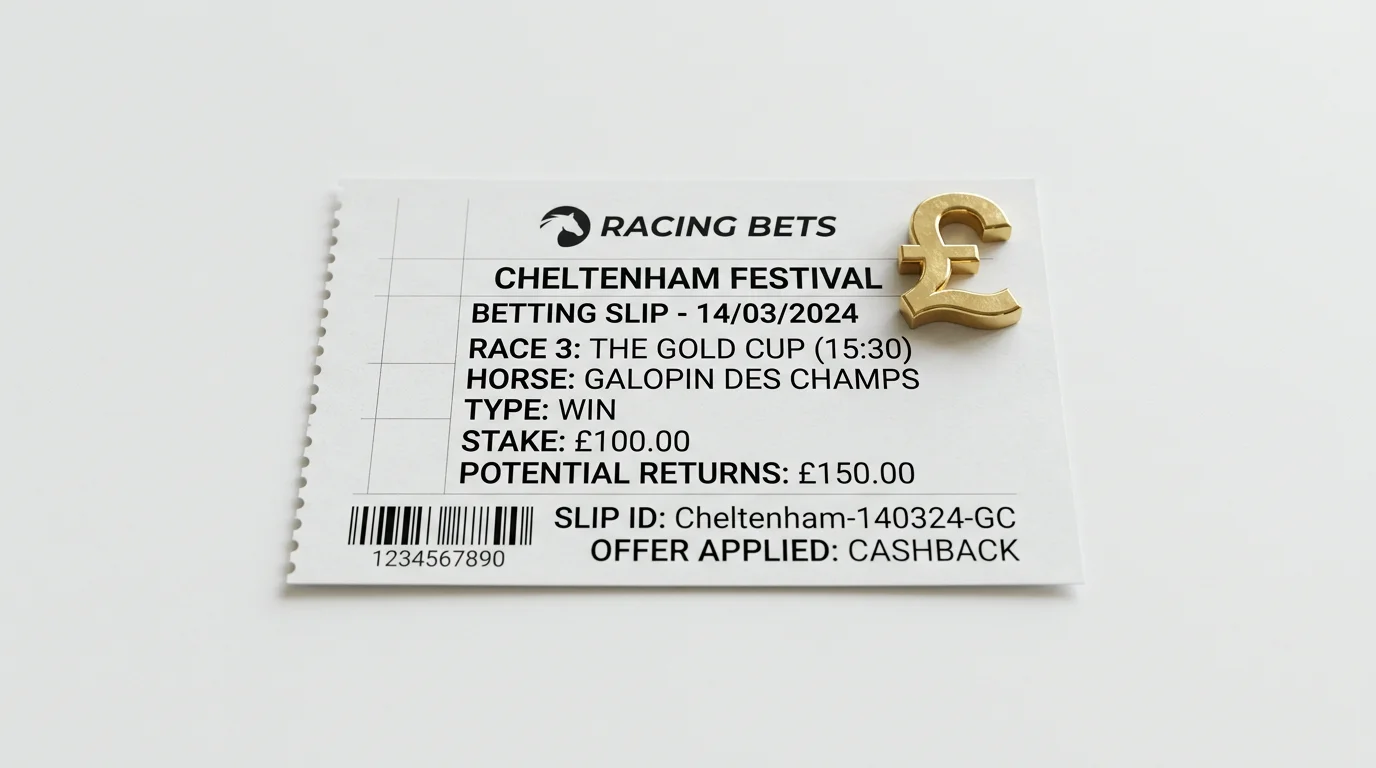
Horse racing cashback offers work on an appealing premise: lose a bet, and a percentage of your loss comes back to you. The concept is borrowed from the casino world, where weekly or monthly cashback on net losses has been a retention tool for years, and it has migrated into sports betting with some important differences. Cashback bonuses — real refund or recycled bet? The answer depends entirely on the form the return takes and the conditions attached to it.
In horse racing, cashback promotions are less common than free bets or extra places, but they occupy a useful niche. For bettors who wager consistently — five or six races a week, week in, week out — a cashback offer that returns 5% or 10% of net weekly losses can quietly outperform a one-time welcome bonus over the course of a year. The question is always whether the return is genuine cashback (withdrawable money) or a rebranded free bet with wagering requirements attached.
Horse Racing Cashback Offers — More on this topic at horse betting bonus.
Types of Cashback in Horse Racing
Cashback promotions come in several flavours, and the differences between them are not cosmetic. Each variant has a distinct trigger, a different calculation basis, and — crucially — a different real-world value to the bettor.
Net loss cashback. The most straightforward version. At the end of a defined period — typically a week or a month — the bookmaker calculates your net losses (total stakes minus total returns) and refunds a percentage. Common rates range from 5% to 15%. If you staked £200 on horse racing during the week, won back £150, and the cashback rate is 10%, your net loss of £50 yields a £5 cashback payment. The period-based structure means that a single big winner in the week can wipe out your eligibility entirely — cashback only triggers when your net result is negative.
Per-bet cashback. Less common but occasionally offered on specific races or events. The bookmaker refunds a flat percentage of each losing bet regardless of your overall result. A 10% per-bet cashback on a £10 losing wager returns £1. The advantage over net loss cashback is that winning bets do not cancel out the refund. The disadvantage is that the percentage tends to be lower (5% is typical), and the promotion is usually limited to a single race or a specific set of markets.
Event-specific cashback. Tied to major festivals or marquee fixtures: “Get 10% cashback on all Royal Ascot bets this week” or “5% back on all Cheltenham Festival losses.” These are acquisition and engagement tools aimed at driving volume during high-profile events. The cashback is sometimes calculated on net losses over the festival period, sometimes on a per-bet basis. Event-specific offers tend to be the most generous in percentage terms, but they run for a limited window and may carry maximum refund caps of £25–£100.
The form of the return is the single most important detail to check. Cash credited to your withdrawable balance is genuine cashback. A free bet credited to your account is not — it requires you to bet again, and since free bets are stake-not-returned, the real value is roughly 70–80% of the stated amount. Some operators label free bet returns as “cashback” in their marketing, which is technically misleading but not uncommon. Always check whether the refund goes to your cash balance or your free bet wallet.
One regulatory change worth noting: since January 2026, the Gambling Commission has banned mixed product promotions. This means a cashback offer on sports betting cannot be bundled with casino bonuses, free spins, or bingo credits. Horse racing cashback must be a standalone promotion tied solely to horse racing or sports betting markets. If you encounter a “cashback” offer that blends racing losses with casino play, the operator may not be fully compliant with the new rules.
Cashback Offers Compared
Comparing cashback offers across bookmakers requires looking at four variables: the cashback percentage, the maximum refund, the form of the return (cash or free bet), and any wagering requirements on the returned funds.
The major operators rarely advertise permanent cashback programmes for horse racing in the way casino brands do. Instead, cashback tends to appear as a periodic promotion — a week-long campaign tied to a festival, a monthly offer for loyalty programme members, or a targeted retention deal sent to specific customers. This makes direct comparison harder than with sign-up offers, where the terms are published and persistent.
What can be said in general terms is that larger operators (bet365, Paddy Power, Coral) tend to offer cashback at lower percentages (5–10%) with higher caps (£50–£100), while smaller operators sometimes offer higher percentages (10–15%) with lower caps (£25) and free bet returns rather than cash. The net value can be similar — 10% cashback capped at £100 as cash is broadly equivalent to 15% cashback capped at £100 as a free bet, once you discount the free bet’s true value.
Some loyalty programmes incorporate cashback as a tier benefit. Reaching a certain level of activity unlocks weekly cashback on racing losses, typically at 5% with no additional wagering requirement. These programmes reward volume: the more you bet, the higher the tier, the better the cashback terms. Whether that incentive structure is healthy is a separate question — for the purposes of evaluating value, it means that consistent bettors can access ongoing cashback that casual punters cannot.
The broader economic context is also reshaping the cashback landscape. According to the House of Commons Library, the Office for Budget Responsibility projects that gambling duty reforms will generate an additional £810 million in 2026/27, rising to £1.16 billion by 2030/31. Analysts estimate that operators will pass roughly 90% of these increased costs onto consumers through reduced payouts, tighter bonus terms, or less generous promotional offers. Cashback percentages are one of the easiest levers for bookmakers to adjust: a move from 10% to 5% halves the promotional cost while still allowing the operator to advertise “cashback.” Punters should track the actual terms they receive, not the marketing label.
Evaluating Cashback Value
The expected value of a cashback offer depends on your expected loss rate. If you bet skillfully and break even or turn a small profit, cashback offers are worth nothing — they only trigger on net losses. If you lose, say, 5% of your total turnover on average (which is broadly in line with the bookmaker’s margin on horse racing), then a 10% cashback offer recovers 10% of that 5%, reducing your effective loss rate from 5% to 4.5%. That is a meaningful edge when compounded over hundreds of bets.
See also Non-Runner Free Bets.
Here is the formula in practical terms. You stake £500 per week on horse racing. Your average weekly return is £475 (a net loss of £25, which equates to the bookmaker’s 5% margin on your volume). A 10% cashback on net losses returns £2.50 per week. Over 52 weeks, that is £130 — not life-changing, but a real reduction in the cost of your betting. If the cashback is paid as a free bet rather than cash, discount it by 25–30%: the £130 becomes roughly £91–£97 in true value.
Cashback is most valuable to bettors who wager consistently at moderate stakes. If you bet infrequently, the offer rarely triggers. If you bet very large amounts, the cap limits the benefit. The sweet spot is a regular punter staking £20–£50 per race across a full Saturday card — someone whose weekly turnover is high enough to generate a meaningful cashback return but low enough that the cap is not the binding constraint.
Compared to alternatives — extra places, price boosts, free bet offers — cashback is the least exciting but most predictable form of value. It does not require you to change your betting behaviour, pick specific races, or opt in to individual promotions. It simply runs in the background and returns a fraction of what the bookmaker takes. For punters who value simplicity and long-term consistency over the dopamine hit of a boosted price, cashback is an underrated tool.
Disclaimer. Gambling involves risk. Only bet what you can afford to lose. All offers mentioned are subject to change and carry terms and conditions set by individual operators. You must be 18 or over to open a betting account in the United Kingdom. If you feel your gambling is becoming a problem, contact GambleAware or call the National Gambling Helpline on 0808 8020 133.
