
 Available in US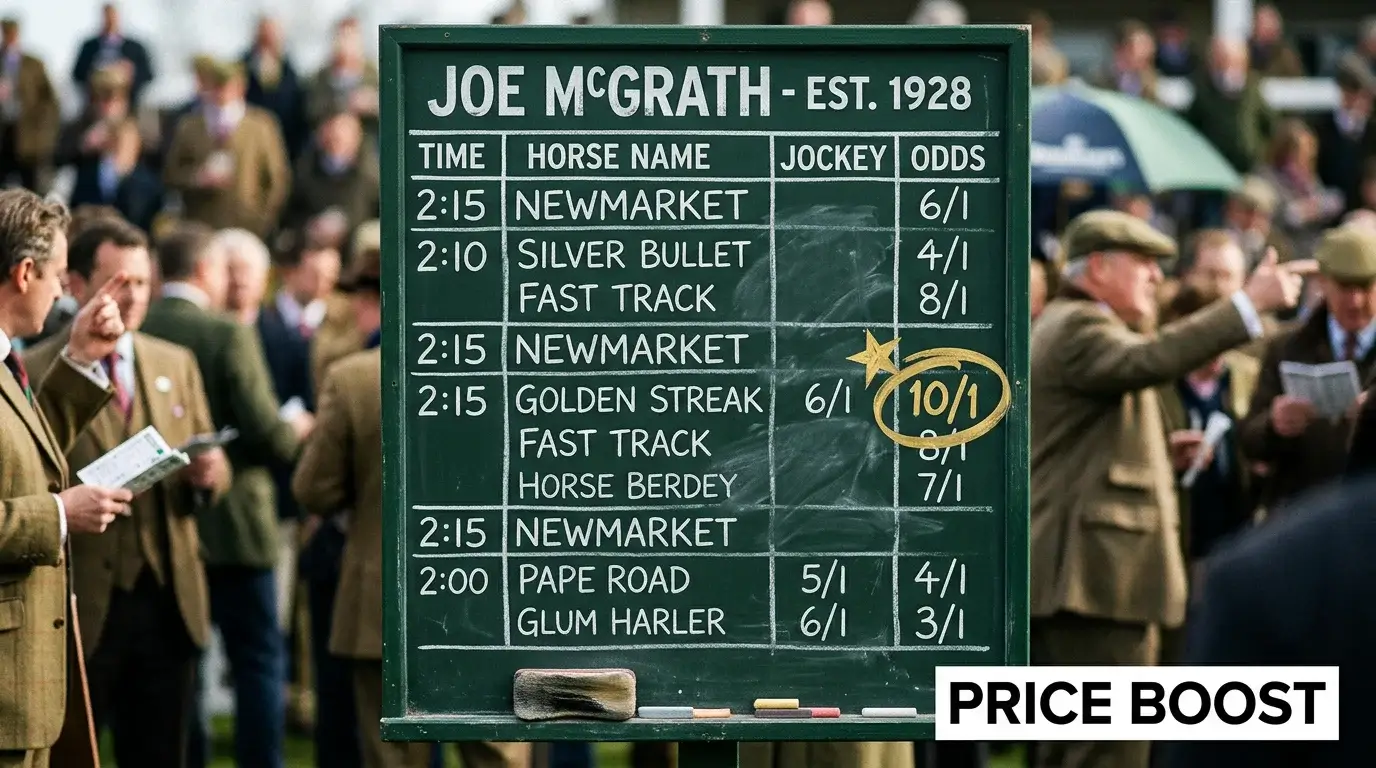
Horse racing enhanced odds — “was 5/1, now 8/1!” — appear on bookmaker homepages with the regularity of the tide. The banner is designed to make you feel like you’re getting a deal. And sometimes you are. But the question that separates a genuine value opportunity from a marketing exercise is deceptively simple: is the boosted price actually better than the best price already available in the open market, or did the bookmaker quietly start with odds below the industry average and then “boost” them to merely normal?
Price boosts — marketing or genuine value? That is the core question this guide addresses. The mechanics are straightforward; the evaluation requires a few extra steps that most punters skip. If you are willing to check a boosted price against the wider market before staking, you can filter the genuinely valuable boosts from the noise. If you are not, you are relying on the bookmaker’s marketing department to give you a fair deal, which is roughly like asking the dealer to count the cards for you.
Horse Racing Enhanced Odds — More on this topic at horse betting bonus.
How Enhanced Odds Work
A price boost is a temporary increase in the odds offered on a specific selection, chosen by the bookmaker. The operator picks a horse (or occasionally a market, such as “any horse from Trainer X to win”), inflates the price above their standard line, and advertises it prominently on their app or website. The enhancement might be modest — 7/2 boosted to 4/1 — or dramatic — 5/1 boosted to 8/1. Either way, the mechanism is the same: the bookmaker absorbs a reduced margin on that specific bet in exchange for the promotional attention it generates.
Most price boosts come with restrictions. The maximum stake is typically capped at £10 to £50, preventing serious bettors from hammering the enhanced price for large profits. Many boosts are limited to “one per customer,” so you cannot place multiple bets at the boosted price. Some are available only to new customers as part of a sign-up offer; others are open to all account holders as a daily promotion. The payout is usually in cash, which distinguishes standard daily boosts from the new-customer enhanced odds offers that often pay winnings as free bets above a certain threshold.
The competitive context matters. According to the BHA’s full-year racing report, total betting turnover on British horse racing fell by 6.8% in 2024 compared to the previous year. In a market where fewer bets are being placed, operators need to work harder to attract each wager. Price boosts serve that function — they are a targeted incentive to bet on a specific race at a specific time, generating engagement on races that might otherwise pass without much attention. For the bookmaker, the cost of offering a few enhanced prices daily is modest relative to the customer acquisition and retention value they deliver.
The format varies by operator. Some bookmakers offer a fixed number of daily boosts — say, three racing boosts per day — that refresh each morning. Others run a single “super boost” on the feature race. A few allow customers to select which bet they want to boost using a daily token, giving the punter more control over where the value is applied. The token-based approach is generally the most user-friendly, since you can apply the boost to a selection you have already researched rather than being restricted to the bookmaker’s chosen horse.
Are Price Boosts Real Value?
The only reliable way to answer this is to compare the boosted price against the best price available elsewhere. Odds comparison tools exist precisely for this purpose — check the boosted odds against the current best available price across all major operators. If the boost is above the best available market price, it represents genuine value. If it merely matches or falls below what another bookmaker is already offering at standard odds, the boost is cosmetic.
In practice, the picture is mixed. When operators boost the price on a well-backed favourite — say, from 5/2 to 3/1 — the boost frequently represents real value, because the standard price across the market is tight and the 3/1 is genuinely above the industry best. When the boost is on a less popular selection — a 14/1 outsider boosted to 18/1 — the value proposition is less clear, because odds on long-priced runners vary more widely between bookmakers, and 18/1 might already be available elsewhere without any promotion.
There is also a structural question about how bookmakers select which prices to boost. The cynical reading is that operators choose horses they believe are unlikely to win, then boost the price to attract bets on losing selections — a form of advertising their own margin. The more charitable reading is that marketing teams pick horses with broad public interest to maximise engagement, regardless of their winning chances. The truth likely sits somewhere between these positions, and it varies by operator and by day.
The tax environment adds another layer. From April 2026, the Remote Gaming Duty rises from 21% to 40% — a near-doubling of the tax rate on online gambling revenue. Horse racing bets are carved out from the heaviest increases (remaining at 15% General Betting Duty), but the broader pressure on operator margins is real. Richard Wayman, Director of Racing at the BHA, has pointed to affordability checks as a primary driver of falling turnover, noting their direct impact on betting activity. In this environment, some analysts expect price boosts to become either less generous (as operators protect margins) or more targeted (concentrated on high-engagement moments to justify the cost). Punters should not assume that the boosts available in January will be identical in quality by December.
A practical rule of thumb: if a price boost is genuinely 15–20% above the best available market odds, it is worth taking at the capped stake. If the enhancement is 5% or less, the bookmaker is essentially offering you their normal price with a promotional label attached. Check, compare, and decide accordingly.
Where to Find Daily Price Boosts
Price boosts are typically published between 8:00 and 10:00 am on race days, with the best selections appearing on the bookmaker’s app homepage or within a dedicated “Boosts” or “Enhanced Odds” section. Some operators refresh their boosts multiple times during the day — an early-morning batch for the lunchtime cards and a second batch for the afternoon features. It is worth checking back if the morning boosts did not appeal.
See also Horse Racing Betting for Beginners.
The major operators all run daily racing boosts, but frequency and quality vary. Bet365 tends to offer multiple boosts across different racing meetings; Sky Bet’s “Price Boost” token allows you to enhance one selection of your choice per day; Paddy Power and Betfair typically run fixed boosts selected by their trading teams, often with a humorous or narrative angle (“Your Saturday Superboost”). Betfred frequently ties boosts to their television partnerships and ITV Racing coverage, meaning the boosted race aligns with the day’s most-watched fixture.
For punters willing to hold accounts with multiple bookmakers — which is the standard approach for anyone serious about maximising value — the daily routine takes five minutes: open each app, scan the available boosts, compare against current market odds, and take any that represent genuine value. Over a year, this habit surfaces dozens of clearly +EV betting opportunities that require no opinion on form, no handicapping skill, and no research beyond a quick odds comparison. It is, per minute of effort, one of the most efficient edges available to a recreational racing bettor in the UK.
Disclaimer. Gambling involves risk. Only bet what you can afford to lose. All offers mentioned are subject to change and carry terms and conditions set by individual operators. You must be 18 or over to open a betting account in the United Kingdom. If you feel your gambling is becoming a problem, contact GambleAware or call the National Gambling Helpline on 0808 8020 133.
